


To Whom It May Concern (You): There’s a question we need to be asking… because it’s what really matters: Who should get the yield? When a government creates money, it captures the difference between what it costs to produce that money and what it buys. That difference is called Seigniorage... That “gain” has belonged to sovereign states for as long as these states have existed. The government earns this money, and then it spends it. The inflation cost of money creation is shared by everyone who holds the currency. However, this financial benefit is theoretically public. That arrangement is starting to change... Last week, we discussed the ongoing shift toward stablecoins in the global political economy. These stablecoins don’t just digitize the dollar. They privatize the yield of the dollar. It’s not done by eliminating the public system... but by layering a private revenue model on top of it. Monetary expansion, which we’ve discussed in its impact on the average person’s past, present, and future time… is still public... The Federal Reserve sets rates, the Treasury issues the bills, and the full faith and credit of the U.S. underwrites the whole system. But the profit from that expansion is flowing to private shareholders. The costs and risks remain heavily socialized. The gains are increasingly centered on private balance sheets. All while the people funding this whole story have little idea they’re participating in it. Welcome back to the Edge of the World. The Ways They TakeHere’s how the stablecoin system works… You give Circle a dollar. They issue you one USDC. That dollar goes into reserves and is invested in short-term U.S. government debt. The asset earns interest… from the U.S. government. You, as the holder, don’t get anything. That difference is the new business model. Under the Guiding and Establishing National Innovation for U.S. Stablecoins Act... the GENIUS Act... every permitted stablecoin issuer must maintain one-to-one reserves in cash, demand deposits, 3-month or less Treasury bills, repurchase agreements backed by T-bills, or government money market funds. So, in practice, payment stablecoins are structured so that the yield on those reserves accrues to the issuer rather than the holder. The law doesn’t need to explicitly ban yield for the outcome to be the same. The structure is what determines who gets paid. Congress didn’t create the spread. Congress allowed the structure to capture it. Circle’s S-1 filing showed approximately $1.68 billion in revenue for 2024 on roughly $33 billion in average USDC circulation. By 2025, with USDC growing past $75 billion and rates holding above 4%, revenue climbed to approximately $2.75 billion. That’s almost entirely reserve income... That was the yield earned on Treasury bills purchased with other people’s money. Now… I need to be clear. They don’t keep it all. Coinbase captures 100% of reserve income on USDC held directly on its platform, and splits roughly 50/50 with Circle on USDC held off-platform. Per Circle’s S-1, that arrangement gave Coinbase roughly 56% of total USDC reserve revenue in 2024... despite Coinbase holding only about 20% of USDC supply. That’s a big cost baked into every dollar of revenue. These economics come from these pathways…
If rates fall, yields compress. If adoption slows, float shrinks. If distribution costs rise, margins tighten. The economics aren’t fixed... but the direction is. This is a volume-driven, rate-sensitive spread business... with margins shaped by policy, not competition. It’s the most financialized thing I could think of in a nation that continues to see a growing shift toward greater financialization… Even with those constraints, the model has incredible structural advantages. Circle, as the issuer, isn’t taking traditional lending risk. They buy the safest short-term asset on the planet and clip the coupon. The risk profile is closer to that of a rate-sensitive utility layered on top of the U.S. Treasury market than to that of a bank. The infrastructure beneath includes everything that screams “America.” You have the dollar’s credibility, the Treasury market’s depth, the Fed’s monetary policy, the military and diplomatic apparatus that maintains confidence in U.S. sovereign debt... Of course, all of that is paid for by taxpayers. Circle earns the yield on top of it. The model already works. The question is who benefits. I must wonder whether anyone decided that this was how it should work, or if this just happened in the background while people were arguing about Bitcoin. The most profitable financial innovation of the decade really just looks like a new toll road built atop public monetary infrastructure.
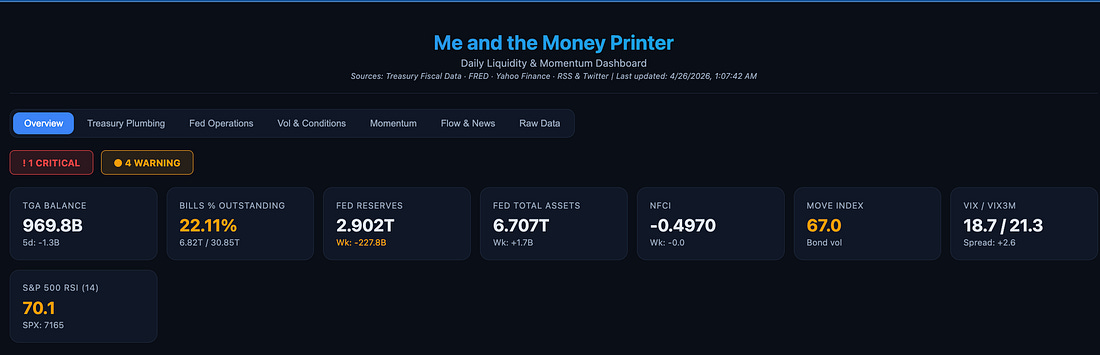
What’s Beneath the NoiseScale all of this up, if you will… USDC currently has about $75 billion in circulation. Tether has more than $180 billion. Together, they represent more than 80% of the stablecoin market. The total market capitalization of all stablecoins exceeds $320 billion and is growing at roughly 50% annually. Two companies control the overwhelming majority of a market that didn’t exist a decade ago. And that’s the point people need to understand… Tether’s attestation reports, audited by BDO, show $141 billion in U.S. Treasury exposure... making it one of the largest owners of U.S. debt… from an offshore location. Its holdings rival nations like Germany, the UAE, and Australia. Circle holds approximately $75 billion. Combined, the two largest issuers hold more than $215 billion in Treasury exposure. Five years ago, that number was about zero. Two private companies... with no deposit insurance, no Federal Reserve access, and no public mandate... hold more short-dated U.S. government debt than most allied nations. They function like systemically important holders... without being treated as systemically important institutions. They’re NOT structured to absorb failure. Tether reported more than $13 billion in profit for 2024 and over $10 billion in 2025. They have very little credit risk and extremely low duration exposure. The entire customer base receives no return on its capital. And as we explained, it’s not about generating that return for many people abroad. It’s about hedging against local currencies that could lose significant purchasing power. That’s a highly efficient form of financial intermediation, with margins that resemble seigniorage more than traditional banking. London Business School economist Hélène Rey talked about this in the IMF’s Finance and Development magazine. The argument goes that “wide adoption of US dollar stablecoins for payment purposes would be equivalent to the privatization of seigniorage by global actors.” Stablecoin issuers issue tokens that circulate as de facto dollars, hold the reserves, and earn the yield. The profit doesn’t flow to a government. It now floods toward private shareholders. How Power Really WorksThe New York Federal Reserve published a historical analysis drawing a direct parallel between today’s stablecoins and the national bank notes that circulated from 1863 to 1935. Under the National Banking Act of 1864, private banks issued their own currency backed by government bonds deposited with the Treasury. Banks earned the yield, while the holders earned nothing. This is the same financial structure in a different century… In February, the Federal Reserve Board published its own paper, “A Brief History of Bank Notes and Lessons for Stablecoins,” making the same conclusion. The private issuance of money that’s backed by government debt is very profitable, scalable, and structurally stable... until things go sideways. Carlson’s data show that roughly 5% of those institutions failed over the period. The notes were safe…. but the banks themselves were not… Last October, the Bank for International Settlements (BIS) published a brief showing that stablecoin holders aren’t generally permitted to earn interest on their balances under current regulatory frameworks. So, we know that the holder gets the token, and the issuer keeps the yield. The European Parliament’s research service went further, describing the U.S. stablecoin strategy as “cryptomercantilism”... a framework using digital payment rails to extend dollar reach while private actors capture the spread. The ECB’s analysis said the dual purpose was “to protect the US dollar’s global dominance by expanding its use on digital platforms worldwide, and to reduce borrowing costs.” That’s not a crypto newsletter or financial publisher near Charles Street rambling… We now have the European Parliament telling its members that the U.S. has just built a system in which private companies export dollars globally, earn the yield, and the U.S. government gets captive demand for its debt. That’s power. The Everyday HustleRight now, 80% or so of stablecoin transaction volume occurs outside the U.S., according to Chainalysis data. What really matters is the scale in dollars. Over 98% of stablecoin market capitalization is denominated in dollars. The use cases... savings protection against currency depreciation, remittances, cross-border commerce... clearly serve populations in emerging markets. The person in Lagos holding USDC isn’t doing it because they’re excited about blockchain. They’re doing it because the naira lost a bunch of its value last year, and the stablecoin didn’t. That’s a rational decision. It’s also a decision that generates revenue for Circle and demand for U.S. government debt, and returns nothing to the person holding it... The SUERF Policy Brief by Miguel Burguet of Marlowe Capital described this as “digital dollarization”... individuals in emerging markets voluntarily adopting dollar stablecoins, creating real demand for U.S. Treasuries through the reserve requirement… with no government or central player demanding them to... Independent analysis Shanaka Anslem Perera drew a historical parallel. He compared it to the original petrodollar system, established in 1974, which required Saudi Arabia to recycle oil surpluses into U.S. Treasuries, with dollar-denominated oil pricing emerging in parallel. The stablecoin system is the digital successor. Instead of oil-exporting governments recycling dollar surpluses, stablecoin issuers hold mandatory dollar reserves. Instead of the oil trade creating dollar demand, digital payments and savings protection create it. It’s the same function… But the whole arrangement revolves around the bigger world of politics. You don’t need diplomatic agreements with a handful of OPEC governments as the Petrodollar did… Instead, this whole thing operates around the whims of individuals. The demand is automatic, decentralized, and self-reinforcing. The holder isn’t being robbed. They’re making a trade. They’re giving up yield in exchange for access to a stable, dollar-denominated asset that moves globally and holds value. In countries where the local currency lost 30% last year, that trade is rational. It might even be a little generous. The Real EconomyThere is a bear case here. Stablecoin economics are rate-sensitive, volume-dependent, and partially intermediated. If short-term rates fall, reserve income compresses. If adoption slows, the float shrinks. In Circle’s case, a significant portion of that revenue is shared with distribution partners such as Coinbase. The latter captures a big share of reserve income tied to USDC held on its platform. On top of this, the risks aren’t financial… A lot of challenges can arise for a spread business built on policy, scale, and distribution. But the direction of this world is clear. Treasury Secretary Scott Bessent has projected the stablecoin market could grow to $3.7 trillion by the end of the decade. That would translate into a multi-trillion-dollar private bid for short-dated Treasuries. Standard Chartered projects $2 trillion by 2028. Citigroup’s bull case runs even higher. The current T-bill market is about $6 trillion, according to our analysis over at Money Printer Pro.
This big stake… could see Stablecoin issuers become a dominant buyer with time. Unlike foreign central banks, which can reduce Treasury holdings for geopolitical reasons... stablecoin issuers must hold reserves proportional to tokens in circulation. The reserves are mandated by law, so we have demand that’s captive, structural, and non-negotiable. The economics flow in two directions. Circle earns the yield on reserves... private seigniorage captured by shareholders. The government earns cheaper borrowing costs as demand compresses Treasury yields. Every dollar parked in a stablecoin is a dollar that must be invested in T-bills by law... which means every new wallet opened in Manila, Medellín, or Nairobi tightens the bid on short-dated government debt. The holder provides the capital that makes both flows possible. They get the utility of a stable digital dollar. You have privatized gains and socialized costs. That’s the oldest formula in finance. But it’s never been applied at this scale, to this many people, with this little public debate. This all happens one wallet at a time, in 100 countries where the local currency can’t compete with a dollar on a phone. Rey’s conclusion for the IMF: “These stablecoins could constitute a digital pillar strengthening the exorbitant privilege of the U.S. dollar.” The exorbitant privilege... the ability of the United States to borrow cheaply because the world needs dollars... isn’t disappearing... It’s being rebooted. At $750 billion in USDC circulation and a 4% yield on reserves, Circle’s annual reserve income would be approximately $30 billion... more net interest income than all but a handful of banks on earth, without making a single loan. They have no tellers, branches, or loan officers. It’s a pool of reserves that are earning a coupon. And underneath all of it, the same question that nobody asked when this started: who decided that the yield on the world’s dollar savings should flow to the shareholders of private companies instead of the public institutions that built the system those companies operate on?
The Sovereign Move (This Week’s Recommendation)If the spread is being captured, the move is to own the operators. We’ve discussed the compliance layer and the consolidation wave. Those picks still hold: NICE, LSEG, MCO, NDAQ, PLTR, TRI for compliance infrastructure. V, MA, FISV, JPM for the M&A layer and settlement networks. Now add the seigniorage layer... the companies that capture the intermediation margin… If you liked this post so far… You can get access to Postcards for $1 a week… Then… once you’re in… you can access our full portfolio… and our latest recommendation… right here… behind the paywall…
About Postcards from the Edge of the WorldThe Postcards Doctrine holds that wealth, power, and stability do not persist through innovation, morality, institutions, or financial sophistication, but through control of chokepoints that remain productive across regime change. Civilizations rise and fall. Ideologies rotate. Technologies obsolete themselves. Financial instruments are rewritten, repudiated, inflated away, or nationalized. What survives is not what performs best in good times, but what continues to function when systems fail, rules change, and authority resets. The doctrine begins with a simple observation: extraction always migrates toward what people cannot avoid. Early on, extraction flows through trade. Then finance. Then regulation. Then platforms. Then metered access. Eventually, it settles on inputs that cannot be substituted, deferred, or digitized. Postcards are sent from the edge of these transitions. Each one documents a moment when the system tightens, when optionality narrows, and when value stops flowing to innovation and starts flowing to ownership. Enjoy.
|









Post a Comment
0Comments