Hello, Thanks for signing up for MarketBeat Daily Ratings—we’re excited to have you on board. Every weekday, you’ll get a curated summary of new “Buy” and “Sell” ratings from Wall Street’s top-rated analysts, the latest stock news, and bonus investing content—all delivered straight to your inbox. You’re just two quick steps away from completing your sign-up: 1. Make sure our emails go to your inboxGmail users:
Mobile: Tap the three dots (…) in the top right and select Move to Inbox or Move to Primary
Desktop: Click the folder icon at the top and select Move to Inbox or Primary Apple Mail users:
Tap our email address at the top (next to From: on mobile), then select Add to VIP Other providers:
Reply to this message and add newsletters@analystratings.net to your contacts 2. Confirm your subscriptionClick this link to confirm your subscription. This verifies your account and ensures you receive your newsletters without interruption instead of getting stuck in your spam filter. Confirm your subscription here. After you confirm, feel free to download our popular free report, "7 Stocks to Buy and Hold Forever" with this link. Thanks again for subscribing—we look forward to being part of your investing journey. 
Matthew Paulson
Founder and CEO, MarketBeat. P.S. If you didn’t mean to subscribe, no problem—you can unsubscribe here.
Additional Reading from MarketBeat
Hilton’s Q1 Report Put One Big Question Front and Center for 2026Author: Chris Markoch. Published: 4/30/2026. 
Key Points
- Hilton delivered a solid Q1 2026 report with earnings, EBITDA, and RevPAR growth meeting or exceeding expectations.
- A potential shift from a “K-shaped” to “C-shaped” economy could broaden travel demand across Hilton’s brand tiers.
- Strong pipeline growth and asset-light franchising position Hilton for long-term expansion despite near-term macro risks.
- Special Report: Elon Musk’s $1 Quadrillion AI IPO
Hilton Worldwide Holdings (NYSE: HLT) reported its Q1 2026 results on April 28, delivering a quarter that largely met Wall Street expectations. Investors were looking for signs of demand resilience, and by that standard they weren’t disappointed. The big question now is whether travel demand is starting to broaden beyond higher-income travelers — and whether that trend can persist through 2026.
The numbers provided a cautiously optimistic picture:
Adjusted earnings per share of $2.01 beat expectations of $1.94 and improved from $1.72 a year earlier. Net income rose to $383 million from $300 million. Adjusted EBITDA climbed to $901 million, up from $795 million. System-wide RevPAR (revenue per available room) grew 3.6% on a currency-neutral basis. The company also raised its full-year 2026 outlook. Full-year system-wide RevPAR growth is now projected at 2% to 3%. Full-year Adjusted EBITDA guidance was set at $4.02 billion to $4.06 billion, and net income guidance was lifted to $1.91 billion to $1.94 billion. The K-to-C Economic Shift: Is It Real and Why It MattersPerhaps most importantly, CEO Christopher Nassetta addressed a shift in the broader economic picture. The so-called "K-shaped" recovery — where upper-income consumers recovered faster while others lagged — now appears to be broadening toward a "C-shaped" pattern, with more consumer segments participating in travel spending. On the earnings call, Nassetta described demand trends as increasingly resembling a "C-shape," signaling wider participation across income groups. Moving forward, investor sentiment about HLT’s trajectory will depend on whether this broader demand base proves durable. The K-shaped dynamic has been evident in Hilton’s results: premium brands such as Waldorf Astoria and Conrad have performed well, while budget and midscale brands showed softer demand earlier in the cycle. A shift toward a broader C-shaped recovery means more consumers are traveling. In Q1, all Hilton brand tiers showed RevPAR gains: Tru by Hilton grew RevPAR 3.7%, Home2 Suites gained 5%, and Hampton by Hilton improved 2.6% — notable strength among brands that cater to everyday travelers. If this demand broadening continues, Hilton's earnings power should increase. More than 8,200 of its 9,146 hotels are franchised, meaning Hilton earns fees with minimal capital risk. Franchise and licensing fees grew 11.4% year-over-year to $696 million. Pipeline Growth Signals Long-Term ConfidenceHilton's development pipeline reached a record 527,000 rooms across 3,768 hotels in 129 countries, a roughly 5% increase from a year ago. During Q1, Hilton opened 131 hotels and added 16,300 rooms to its system. Net unit growth was 6.3% year-over-year. Management reiterated confidence in achieving 6% to 7% net unit growth for full-year 2026. Nearly half of the pipeline rooms were under active construction, and more than half were located outside the United States, signaling strong international expansion momentum. Notable international openings included the Waldorf Astoria Rabat Sale in Morocco and a Motto by Hilton in Brazil. New deal activity included signing the first Motto in Australia and two LXR properties in Japan. This geographic diversification reduces dependence on any single market and helps capture growing international travel demand. On the capital-return front, Hilton repurchased 2.7 million shares at an average price of $301.71, returning $860 million to shareholders in Q1. Full-year 2026 capital return is projected at approximately $3.5 billion. Technical Analysis: Stock at a CrossroadsDespite the positives, HLT was down more than 5% the day after earnings. That pullback appears to be profit-taking after the stock’s strong run since its May 2025 low near $230. The 50-day moving average at $312 is rising and offers a logical support zone on pullbacks. An RSI reading of 51 is neutral, suggesting the decline is likely short-term profit-taking rather than a sign of fundamental deterioration. Some investors remain uncomfortable with Hilton's valuation, which trades at a premium to its historical norms and to the sector. A retest of support around $312 is not unusual and could set up additional upside toward the consensus price target of $348.09. 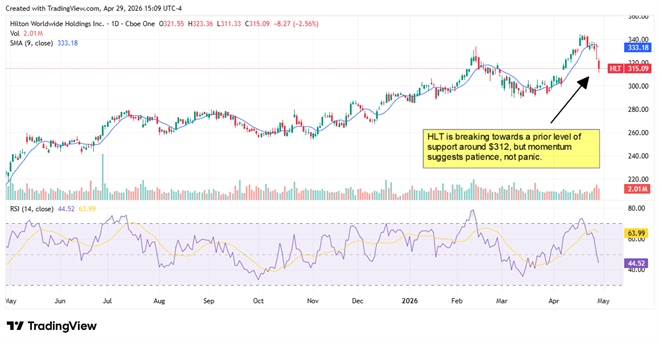
Risks to the Growth StoryInvestors should weigh several risks against the long-term growth case. Geopolitical concerns remain a factor: Middle East RevPAR fell 1.7% in Q1, and management flagged the region as a continuing headwind into Q2. Hilton's $12.5 billion debt load also warrants monitoring. Rising interest rates or tighter credit conditions could pressure margins. And while the K-to-C demand shift is encouraging, it is not guaranteed; a renewed economic slowdown could reverse the trend. Finally, Q2 year-over-year comparisons will be tricky because one-time benefits boosted Q2 2025 results. That could make this year's Q2 appear underwhelming by comparison, even if underlying performance remains solid. |




Post a Comment
0Comments