

Dear Fellow Investor,
Picture the fastest computer you can imagine.
Now picture it sitting next to an old typewriter.
George Gilder believes that massive difference is where today's AI is headed.
The reason is a new kind of chip.
It is called wafer scale technology.
Today’s chips are made by slicing a silicon wafer into many small chips.
This one uses the whole wafer as a single giant chip.
George says it can do in minutes what today's AI needs days to finish.
And it does it on a fraction of the power.
He believes the giant data centers running AI today could end up as tomorrow's typewriters.
George will not name the company behind this chip in public.
But he will hand it to you if you take a look.
See the chip that could retire today's AI
To the future,

Roger Michalski
Publisher, Eagle Financial Publications
VMware: Broadcom's Second Biggest Business Set to Accelerate
Authored by Leo Miller. Published: 6/19/2026.

Key Points
- Broadcom's AI chip sales dominate the conversation around this stock, given its incredible growth rates.
- However, its software business, centered around VMware, is also massive.
- Importantly, the company expects software growth to take off next quarter, providing another reason for optimism around Broadcom.
- Special Report: The company SpaceX cannot operate without
For good reason, investors have come to see Broadcom (NASDAQ: AVGO) as a clear leader in the artificial intelligence semiconductor market. The company’s AI semiconductor revenue jumped 143% year-over-year (YOY) in its latest quarter to $10.8 billion, or 49% of total sales. Broadcom is still well behind NVIDIA (NASDAQ: NVDA) in AI chip sales, however, with NVIDIA’s data center revenue coming in at an astonishing $75.2 billion.
Even so, Broadcom remains well ahead of other AI chip companies like Advanced Micro Devices (NASDAQ: AMD) and Intel (NASDAQ: INTC). Broadcom’s AI chip revenue was $5 billion higher than AMD’s Q1 2026 data center sales of $5.8 billion. Meanwhile, AI chip sales were more than double Intel’s Data Center and AI (DCAI) revenue of $5.1 billion. Broadcom expects a major acceleration next quarter, guiding for AI semiconductor growth of more than 200% YOY to $16 billion.
I paid $5,000 to hear Elon say this (Ad)
One investor paid $5,000 to be in a private room with Elon Musk in Los Angeles - and what he heard confirmed a conviction 15 years in the making.
Musk is launching a project 27 years in the making that could be his biggest move yet. One analyst believes there is a single stock positioned to benefit most - and he is giving away the name for free.
Get the free stock pick tied to Elon's most ambitious projectHowever, a key part of Broadcom’s business sometimes gets overlooked amid the massive attention AI chips receive. That business is infrastructure software, anchored by VMware. For investors, this is a critical part of Broadcom’s story to understand, as AI is far from the only area where the company expects to drive growth.
Infrastructure Software: A Large Chunk of Broadcom’s Business
Broadcom’s revenue breakdown shows why infrastructure software is an important part of its business and why investors need to keep it in view. In its Q2 fiscal year 2026 (FY2026), infrastructure software generated $7.2 billion in revenue. That accounted for a very significant 32% of its $22.2 billion in total revenue. (Note that Broadcom’s fiscal reporting period is slightly ahead of the standard reporting period used by many companies.)
Still, all eyes are on AI chips, since this is where Broadcom is generating the vast majority of its growth. For perspective, infrastructure software revenue grew just 1% YOY two quarters ago and 9% YOY last quarter.
That segment’s growth has slowed considerably compared with fiscal year 2025, when infrastructure software sales posted impressive growth of 26% YOY. That was largely due to the extensive price increases Broadcom implemented after buying VMware. Given this dynamic, some investors have argued that Broadcom has exhausted its price-increase-driven growth and that software sales may stagnate again. However, Broadcom’s latest commentary strongly pushed back on that idea.
Broadcom Forecasts Highest Software Growth in Over a Year
In Q3 FY2026, Broadcom expects a meaningful reacceleration in software growth. The company projects sales of $8.9 billion, or an increase of 31% YOY. Notably, this would mark the company’s fastest software growth rate since the beginning of 2025.
Even more telling were CEO Hock Tan’s comments about the software business going forward. Tan said, “As you can see, in Q3, we're seeing an accelerated growth, and we expect that to continue, I guess, for the next multiple quarters as this demand picks up.” It is unclear whether this means Tan expects growth to accelerate beyond 31% in the future. At the very least, though, Tan is pointing to stronger growth than the recent single-digit figures.
Tan also gave a very confident answer to the one analyst question specifically focused on software. Citigroup analyst Atif Malik asked, “Are you guys seeing any impact of AI, agentic AI, on your software growth and renewals? And if you can just talk about some sort of long-term growth for that business.”
This question touches on a fear that has shaken many software stocks: AI-driven disruption. Tan responded, “Well, we're not seeing it… We do not expect to see any impact on software products.” Here, Tan is clearly saying that he is not seeing a negative impact from AI on software sales and does not expect one going forward. Much of this rationale stems from VMware's tight integration with computing hardware. VMware helps manage the allocation of computing resources, making displacement difficult. In addition, the proliferation of AI requires more computing resources. In turn, that should increase the importance of managing those resources, which is exactly the service VMware provides.
Broadcom’s Software Segment: A Solid Supplement to Hyper-Growth AI Chips
Broadcom’s software business is not only large, but the company also expects it to grow strongly going forward. Meanwhile, there are solid reasons to believe that AI is a positive for its software business rather than a clear threat. To top it all off, this segment is extremely profitable. It generated a gross margin of 93% last quarter, and the operating margin rose 310 basis points YOY to 79%. Overall, Broadcom’s undeniably strong AI semiconductor business is far from the only reason to have confidence in this stock’s outlook.
This Single Factor Is Holding Back Carvana’s Disruptive Edge
Authored by Chris Markoch. Published: 6/26/2026.

Key Points
- Carvana’s Q1 results showed record vehicle sales and improving margins, highlighting continued operational momentum.
- High auto loan rates may be the biggest obstacle for CVNA stock as financing-sensitive buyers face affordability challenges.
- Analysts remain optimistic on Carvana, but investors are waiting for Q2 earnings and clearer signals from the Federal Reserve.
- Special Report: The company SpaceX cannot operate without
Carvana (NYSE: CVNA) delivered a genuinely impressive Q1 2026 earnings report that included a record number of units sold.
Even so, in the two months following the report, CVNA is down approximately 15% despite favorable analyst sentiment. That includes a 10% drop on June 17 in sympathy with cost commentary from CarMax (NYSE: KMX), even though Carvana's own unit economics are moving in the opposite direction.
I paid $5,000 to hear Elon say this (Ad)
One investor paid $5,000 to be in a private room with Elon Musk in Los Angeles - and what he heard confirmed a conviction 15 years in the making.
Musk is launching a project 27 years in the making that could be his biggest move yet. One analyst believes there is a single stock positioned to benefit most - and he is giving away the name for free.
Get the free stock pick tied to Elon's most ambitious projectAfter the company’s strong Q1 numbers, Carvana still has operational fuel left in the tank. For example, the company’s AI-driven reconditioning tools haven't been rolled out at most facilities, meaning there is still room for further margin expansion.
The company's new Stellantis (NYSE: STLA) hybrid hub model has also shown early traction. The Casa Grande franchise reportedly went from 30 to 50 units per month to more than 700 after Carvana took it over.
Why Is CVNA Under Pressure?
With all these positive factors supporting the stock's outlook, why is CVNA under pressure? Some may say the issue is valuation. At 41x forward earnings, Carvana is priced like a technology stock. But the company’s innovative, online-only model has been disruptive to a market that wasn’t known for innovation. And although the company doesn’t have a long history of profitability, the 41x figure is a discount to its historic average.
The company also cited the likelihood of lower gross profit per unit (GPU) in the coming quarter for a variety of reasons, including the year-over-year comparison to last year’s tariff anniversary. But that’s likely to be a one-time event and wouldn’t explain a sell-off that is now over 20% in 2026.
Carvana Is More Sensitive to Financing Conditions
The real pressure on CVNA is likely coming from something outside of its control: the near-term direction of U.S. monetary policy. The tone of Federal Reserve chair Kevin Warsh's statements on June 17 did not indicate that he intends to move toward an accommodative stance anytime soon.
The CME FedWatch tool agrees. The odds of a rate cut for the rest of 2026 are not even given a percentage. This may not satisfy investors who want to sharpen their pencils and look for a mathematical reason to sell Carvana in the company’s financials. But before dismissing it, here’s something to consider.
For an auto retailer, interest rates matter because auto loan rates are among the stickiest in consumer credit. The average used car APR is well above 11%. Trade-ins increasingly carry negative equity. A consumer who barely qualifies at current rates gets squeezed harder if rates hold or rise.
Something else to consider: Carvana's competitor CarMax recently delivered earnings and, despite beating estimates and growing penetration, saw net income drop nearly 12% to $185.6 million as it cut prices to defend volume. Its loan-loss reserve also climbed to 2.95% of loans, up from 2.78%, as the company leaned harder into Tier 2. This is a category of consumers with strong but not top-tier credit who usually qualify for rates that carry a cost premium.
The typical Carvana customer skews to a lower FICO score than CarMax and is more dependent on financing. When rates stay high, marginal buyers are the first to be disqualified, and those are disproportionately Carvana's customers. There's also a K-shaped wrinkle to consider. Upper-leg consumers are still spending, but they're prioritizing travel and experiences over big-ticket vehicle purchases.
That gives fundamental investors something to consider. Restrictive policy compresses growth multiples hardest. At a 41x forward multiple, Carvana needs growth to deliver.
If higher-for-longer rates take $1 of earnings per share (EPS) away from CarMax, it could take 10x off CVNA's multiple. That puts Carvana’s 5-for-1 split last quarter into a different light.
Analysts Remain Bullish, But Technicals Stay Weak
Institutional buying was down sharply in the last quarter, but since the company’s earnings report, analysts have been mostly bullish on CVNA. The Carvana analyst forecasts on MarketBeat show a consensus price target of $93.14 as of June 24, representing a significant gain for investors. However, investors may have to wait until after Carvana reports earnings next month to get a better picture of analyst sentiment.
The CVNA chart shows a stock that continues to be in a downtrend, with recent rallies failing to break through the 200-day simple moving average. A bigger concern for investors may be volume, which is down sharply. The MACD also remains below its signal line, with the histogram near zero. There’s simply no real conviction one way or the other, which amplifies short interest of around 7%, which in and of itself isn’t bearish.
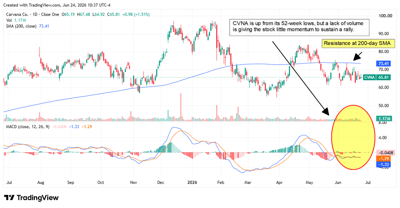
The next potential catalyst comes with Carvana's Q2 earnings report scheduled for July 29. Until then, CVNA is likely to stay tethered to macro signals rather than its own execution. The numbers say the company’s business model is working. The question is whether the Federal Reserve cooperates before the multiple compresses further.
This message is a sponsored email from Eagle Publishing, a third-party advertiser of The Early Bird and MarketBeat.
If you have questions about your account, please feel free to email our U.S. based support team at contact@marketbeat.com.
If you no longer wish to receive email from The Early Bird, you can unsubscribe.
Copyright 2006-2026 MarketBeat Media, LLC. All rights protected.
345 N Reid Pl. #620, Sioux Falls, SD 57103-7078. USA..
Post a Comment
0Comments