

Louis Navellier: "This Could Be Bigger Than Nvidia"

Popular Fox News guest Louis Navellier sat down for a tell-all interview on Elon Musk's little-known AI project in Tennessee. He reveals why competitors are flying spy planes overhead… and details three little-known stocks (not Tesla) he believes will soar from this $7 trillion shift.
Why Wall Street Still Sees Massive Upside for AeroVironment Stock
Authored by Thomas Hughes. Article Published: 6/30/2026.
Key Points
- AeroVironment's fiscal Q4 revenue surged 133.3% year-over-year, with adjusted EPS of $1.84 coming in roughly 2,500 basis points above forecasts.
- AVAV shares rose 20% following the FY2026 release, with a 1.4X book-to-bill ratio and a $1.2 billion backlog supporting FY2027 growth guidance.
- Share dilution from the all-stock BlueHalo acquisition is fading as institutions, which own approximately 85% of AVAV, continued buying during the correction.
- Special Report: Forget SpaceX. Buy the company Musk can't replace.
AeroVironment’s (NASDAQ: AVAV) share price has faced plenty of headwinds, enough to drive the stock to long-term lows despite broad strength among drone makers. The key takeaway, however, is that those headwinds are easing, and fiscal year 2027 (FY2027) guidance points to a solid year ahead.
Although guidance came in slightly below the consensus estimate, analysts had braced for worse, with whisper numbers sitting at the low end of the range. Looking ahead, AeroVironment’s now-diversified defense business gives it a strong chance to continue gaining traction, creating value for shareholders and ultimately supporting a full recovery in the stock price.
Central banks bought 710 tonnes - this fund pays monthly (Ad)
Gold is hitting new highs, fueled by tariffs and record central bank demand - 710 tonnes per quarter. JPMorgan is now targeting $4,900.
One $15 fund is converting gold's momentum into up to $1,152 per month in payouts. No miners, no active trading - just monthly income.
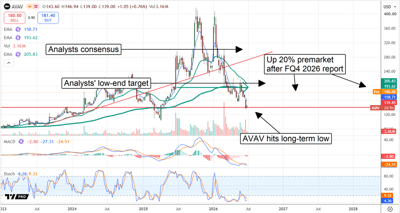
See how to collect your first payout before the next surgeThe technical setup is clear. AVAV sold off sharply in early 2026, shedding approximately 65% from its peak, but then reached long-term support aligned with a critical pivot point ahead of the release, marking a bottom for this market. That pivot point is the 2021 high, which was broken in 2024 and tested again in 2025. The 2025 test triggered a strong market response, as did the fiscal Q4 earnings release. Following the June 29 earnings report, the stock surged 20% in premarket trading before giving back some of those gains at the open.
With this move, AVAV has not only signaled a bottom, but also a strong probability of extending its rebound in the near, mid, and long term.
AeroVironment Outperforms in 2026, Guides for Growth in 2027
AeroVironment delivered a solid fiscal Q4 despite analysts’ concerns. Whether or not the Satellite Communications Augmentation Resource (SCAR) contract is ultimately lost, the company’s products remain in demand, with organic and acquisition-driven growth combining to lift revenue 133.3% year-over-year (YOY). Revenue beat MarketBeat’s consensus by nearly 1,500 basis points (bps), with strength across all reporting segments. Product sales rose 106%, led by a 334% increase in services.
The only downside was that acquisitions altered the product mix and compressed the company’s gross margins. Even so, revenue growth more than offset the pressure, leaving cash flow and earnings ahead of expectations. Adjusted earnings per share (EPS) of $1.84 rose modestly relative to the triple-digit top-line increase because of a higher share count, but it still came in roughly 2,500 bps above forecasts, underscoring balance sheet strength and a healthy outlook.
Guidance was the real catalyst. While the company’s outlook came in slightly below consensus, falling estimates meant it was much better than it could have been. The takeaway is that AVAV is forecasting modest double-digit revenue growth and margin strength supported by its book-to-bill ratio and backlog. Book-to-bill, a measure of new orders relative to filled orders, is running at 1.4X, driving the backlog up more than 70% YOY to $1.2 billion, or more than 50% of the FY2027 revenue forecast.
Analysts Highlight Deep Value Opportunity: Institutions Bought the Correction
Some analysts expressed caution following the release because of near-term headwinds, but the group remained generally optimistic. Commentary focused on Q4 strength and the likelihood that AeroVironment could outperform guidance.
AVAV’s revenue tends to be back-end loaded, as is typical for defense contractors, with 55% or more expected in the second fiscal half. No analyst revisions were issued immediately after the release, leaving the consensus unchanged.
Before the earnings release, the consensus analyst price target implied more than 100% upside from the critical support level. Going forward, an important detail is the lowest analyst target of $205. Even on the low end of the range, it implies 45% upside from critical support and would be enough to move the stock above its long-term exponential moving average, signaling a technical reversal.
Institutional trends show that this group bought AVAV throughout its correction. Institutions own approximately 85% of the stock and bought at a pace of nearly $2 per $1 over the trailing 12 months (TTM), and they will likely continue to provide support in coming quarters. Catalysts for continued ownership include manufacturing business scaling, margin improvement, and BlueHalo integration.
Dilution Threat Gone: Clear Skies Ahead
One of the issues pressuring AVAV’s stock in early 2026 was share issuance tied to its BlueHalo acquisition. Because the deal was all-stock, AVAV’s share count increased by an average of 78% YOY as of fiscal Q4, creating a significant market overhang. The story in 2027, however, is that the company is well-capitalized and does not need to raise additional funds.
The result is that the overhang is fading as business traction returns, leaving the market free to move higher in the coming quarters. The balance sheet reflects the effects of an aggressive acquisition strategy, with liabilities and debt higher, but the company remains financially healthy, with low leverage and improving equity.
This year’s biggest risk is negative free cash flow. The company will improve core margins, but spending on expansion, acquisition integration, and scaling will weigh on cash flow. Even so, cash flow and balance sheet metrics suggest the company can easily sustain operations and maintain financial health; the risk is that share-price upside could remain limited until there is better visibility into cash flow and free cash flow.
Tesla's New NHTSA Probe Lands at the Worst Possible Time
By Sam Quirke. Originally Published: 6/24/2026.

Key Points
- Tesla is facing a fresh National Highway Traffic Safety Administration probe after a Model 3 crashed into a home in Texas, the latest in a long line of regulatory investigations into the company’s vehicles.
- The timing of the headline couldn't be worse, with the stock continuing to trend lower from its May high and no clear near-term catalyst.
- However, the bigger picture for long-term investors hasn't shifted, with the company's AI, robotics, and SpaceX merger narratives still firmly intact.
- Special Report: Forget SpaceX. Buy the company Musk can't replace.
Shares of Tesla Inc. (NASDAQ: TSLA) are down about 15% from the May high and are starting to form a pattern that investors won’t want to see. The broader narrative around the company has become more interesting by the month, from Wall Street’s enthusiasm around its full self-driving (FSD) and robotaxi projects to the increasingly serious conversation about a Tesla and SpaceX (NASDAQ: SPCX) merger.
This week, however, brought a much less welcome development — the kind of headline that could further darken sentiment in the short term. On Monday, June 22, the National Highway Traffic Safety Administration (NHTSA) opened a fresh probe into Tesla after one of its Model 3 vehicles crashed into a residential home in Texas, resulting in a fatality.
This is what I’m recommending my readers do now that SpaceX is public… (Ad)
The SpaceX IPO wasn't the big trade - according to Larry Benedict, founder of The Opportunistic Trader, it was the trigger. Benedict, who delivered a 279% return on cash in 2025 across a 20-year winning streak, says the listing launched what he calls the 'Final Phase of Elon's Master Plan.'
He's identified one specific ticker - not SpaceX, Tesla, or any Elon-affiliated company - that he believes could see billions in inflows as this phase unfolds. He calls it his trade of the year.
Watch the video now to get the ticker name and full trade detailsThat this is simply the latest in a long line of regulatory investigations into Tesla will concern investors, and it’s the last thing the stock needed. The main question is how much weight to give it.
What the Probe Is Actually About
The NHTSA’s investigation centers on a fatal crash in Katy, Texas, where a Tesla Model 3 struck a residential home and caused a fatality. The agency has opened what it calls a special crash investigation, the same type of inquiry it has used dozens of times over the past decade to examine Tesla incidents involving its driver-assistance technology.
Early commentary from Tesla itself is also notable. CEO Elon Musk suggested publicly that the high-speed nature of the crash did not fit Tesla’s typical FSD profile, which is designed to operate at much lower speeds on neighborhood streets.
There is, of course, the possibility that the driver manually overrode the system at the time of the crash. Still, regardless of what actually happened, the optics are not good. These investigations take time to resolve, and until they do, headlines like this are the kind that can spook investors, big and small alike.
Why This Stings, Even If It Shouldn’t
The NHTSA has been ramping up its scrutiny of Tesla’s FSD in recent months, and the broader regulatory backdrop has not been getting any easier. This ongoing pattern of investigations has been a slow drip of negative sentiment, clearly wearing on the stock.
The real kicker for investors is the timing of this latest probe. Tesla had been trying to build a fresh uptrend after a difficult start to the year, and the broader bull case around AI, robotics, and the SpaceX merger thesis had been steadily attracting renewed interest.
However, the stock is currently 15% off its May high and at risk of forming a clear downtrend. The frustrating reality for long-term bulls is that the underlying business story hasn’t actually changed. Stocks like Tesla, however, trade on narrative as much as on numbers, which makes them especially vulnerable to situations like this.
The Bigger Picture Still Holds
That said, those with a long enough time horizon need to keep this firmly in perspective. As we highlighted recently, the most important conversation around Tesla right now isn’t about Model 3 safety records. It’s about whether the company is on the verge of one of the most consequential corporate combinations in history. Wedbush’s Dan Ives recently put the odds of a Tesla-and-SpaceX merger within the next year at 80%, and SpaceX’s recent IPO has turned that conversation from theoretical to very real.
In that context, a single NHTSA probe, even one that grabs headlines, does not materially alter the long-term story. FSD remains a key pillar of Tesla’s valuation, but the broader thesis now includes robotaxis, Optimus, energy storage, and the prospect of integration with SpaceX’s AI and satellite ecosystem. Investors with conviction in the bigger picture are unlikely to be shaken loose by a single regulatory headline, however tragic or serious it may sound on the surface.
It’s Easier to Remain Bullish
Sure, the short-term picture is a little uncomfortable, and there’s a chance things get worse before they get better, especially given how weak the stock has been trading in recent weeks. The lack of a clear catalyst isn’t helping, and the company’s next earnings report isn’t due for another month.
But for investors who believe in where Tesla is ultimately headed, this kind of pullback is more likely to look like noise than anything else. The stock has been here before, and every previous regulatory wobble has eventually given way to the bigger story that continues to evolve within Tesla. Until then, patience remains the price of admission, and for those willing to pay it, the potential reward keeps growing.
This email message is a paid advertisement for InvestorPlace, a third-party advertiser of DividendStocks.com and MarketBeat.
This ad is sent on behalf of InvestorPlace Media at 1125 N. Charles Street, Baltimore, Maryland 21201. If you're not interested in this opportunity, please click here.
If you have questions or concerns about your account, feel free to contact MarketBeat's South Dakota based support team at contact@marketbeat.com.
If you no longer wish to receive email from DividendStocks.com, you can unsubscribe.
Copyright 2006-2026 MarketBeat Media, LLC. All rights protected.
345 N Reid Pl., Sixth Floor, Sioux Falls, South Dakota 57103-7078. United States..
Post a Comment
0Comments