BIC NEW YORK — The quality of relationships among individuals, communities, and governing institutions shapes how societies can address their most pressing challenges. When those relationships are marked by tension, competition, or purely transactional expectations, collective capacity is diminished; when they are animated by genuine partnership and a shared sense of purpose, new possibilities emerge.
These ideas were central to the Bahá'í International Community's (BIC) engagement at the 64th session of the United Nations Commission for Social Development (CSocD64), held this month at UN Headquarters in New York.
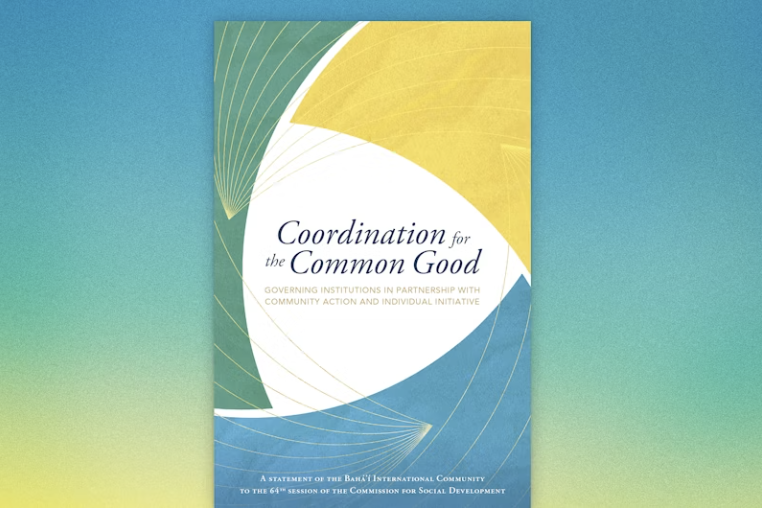
The Commission's priority theme this year—advancing social development and social justice through coordinated, equitable, and inclusive policies—offered the BIC an opportunity to reflect on the conditions that allow coordination to genuinely take root. Drawing on the experiences of the global Bahá'í community in contributing to social progress, the BIC released a statement ahead of the session, titled "Coordination for the Common Good," which examined the distinct roles of three social actors: the individual, the community, and the institution and the quality of relationships among them.
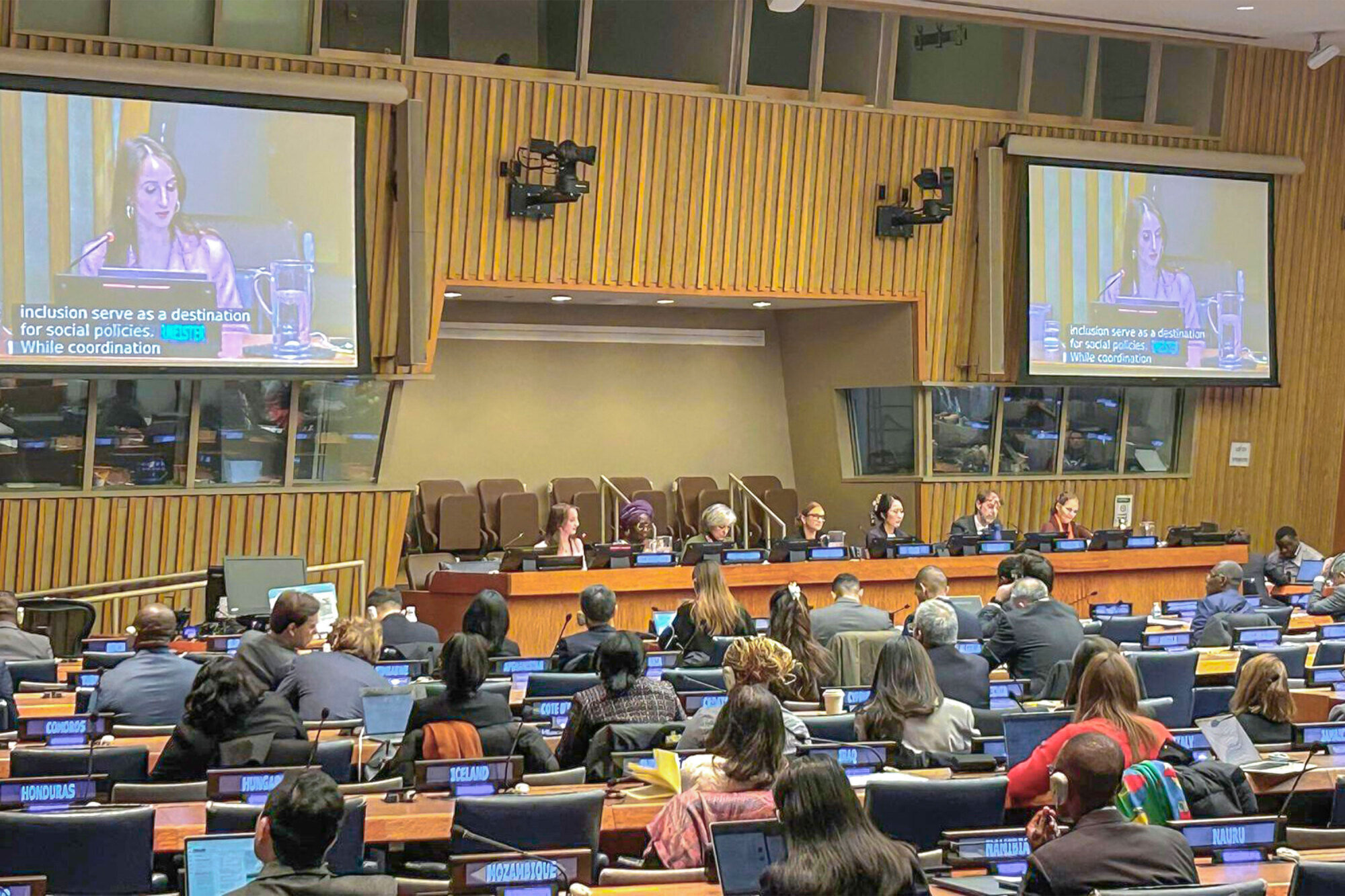
Speaking at a high-level panel discussion on the opening day of the Commission, BIC Representative Cecilia Schirmeister observed that around the world, development tends to advance most effectively when the efforts of governing institutions, community groups, and individuals reinforce rather than duplicate or undermine one another.
"In places where the relationships among the individual, the community, and the institutions are animated by partnership, collaboration, and coordination," Ms. Schirmeister noted, "development is more responsive to the population's needs."
She went on to describe what such coordination requires in practice: social actors coming together to identify shared aspirations, building a common narrative around a vision of the future, and learning to operate with humility—recognizing that neither the questions nor the answers can be discovered without the people themselves.
Central to this, Ms. Schirmeister suggested, is reconceiving what community itself means. Rather than simply the aggregate of the individuals within it, community can be understood as an actor in its own right—one that, through spaces for consultation and collective reflection, enables people to see themselves as participants in a shared enterprise rather than isolated actors.
When that sense of ownership takes hold, voluntary initiative tends to flourish, and collaboration with institutions becomes a natural expression of shared purpose rather than a reluctant necessity.
A side event hosted by the BIC during the Commission brought these ideas to life with examples of concrete experience. Neda Badiee Soto and Alejandro Sarmiento González, two members of the Bahá'í community of the Canary Islands, shared how years of community-building efforts there—focused on applying moral principles through acts of service—have gradually fostered stronger bonds of trust, a sense of local ownership, and growing cooperation with municipal authorities.
Over time, these efforts have given rise to locally led development initiatives responding to neighborhood needs, ranging from women's empowerment, environmental restoration, and immigrant resettlement to tutorial assistance, community health, and parenting support.
One initiative they described in detail was a network of community day camps that arose several years ago from the concerns of working families.
Unable to afford private camps during school holidays, groups of neighbors began consulting together about their needs and aspirations and decided to create their own camps, relying on volunteers from across the community.
Starting with a single camp and fewer than 100 young volunteers in 2020, the initiative has grown to encompass 11 camps across four islands, involving more than 300 volunteers and over 1,400 participants.
What proved significant, Mr. Sarmiento González explained, was how local institutions came to engage with the effort—not by directing it, but by responding to what the community itself had identified as being needed.
Municipal authorities began providing meals and facilities once they saw the impact the camps were having on the social fabric of their neighborhoods. "The community," he reflected, "is truly the one that knows and can understand its own reality."
Ms. Badiee Soto pointed to the principle underlying this evolving collaboration: "Experience suggests that these three actors—individuals, communities, and institutions—fully realize their potential by strengthening their relationship with one another. And there is one cardinal principle that shapes and defines these relationships—cooperation and mutual support."
The BIC's engagement at CSocD64 drew on its statement, available at bic.org, which explores how such grassroots patterns of collaborative life can offer lessons not only for local communities but for policymakers at all levels. 











Post a Comment
0Comments